Table of contents
Table of contents

Need advice before you get started?
Book an appointment

Need advice before you get started?
Book an appointment
Consultation time: a scarce resource under pressure
Medical consultations, whether in the community or in hospital, are at the heart of every care pathway, and yet they are now conducted in increasingly limited time.
Around the world, health systems face the same pressure: clinical time is shrinking, while doctors must see ever more patients within a limited consultation time.
In the latest comprehensive international study published in BMJ Open (data up to 2016), covering more than 28 million consultations in 67 countries, it is shown that the average length of a primary care consultation varies greatly across health systems. It can be extremely short in some countries, such as Bangladesh (48 seconds), or exceed 20 minutes in others, such as Sweden (about 22.5 minutes).
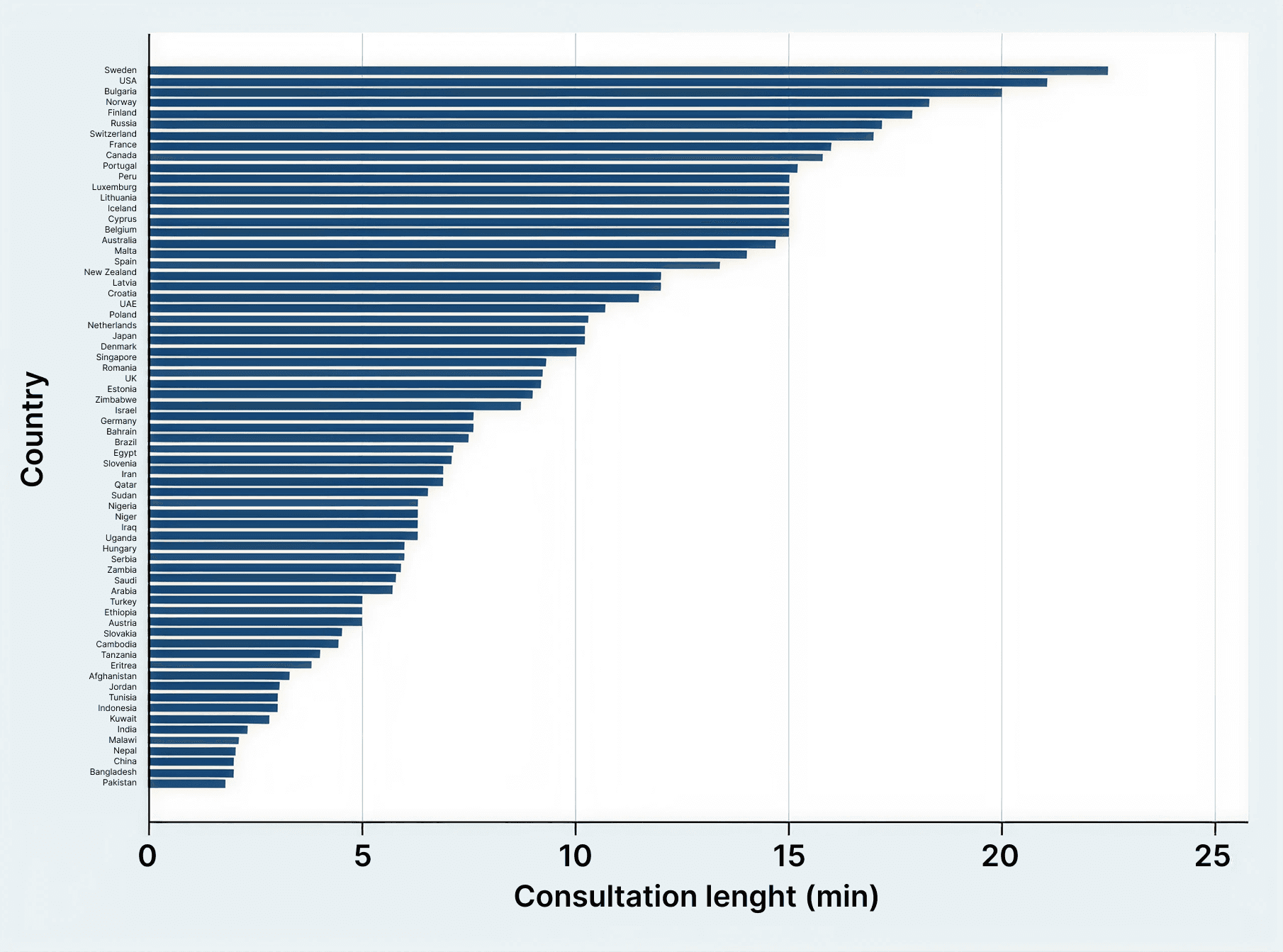
Source: Irving G. et al., International variations in primary care physician consultation time: a systematic review of 67 countries, BMJ Open, 2017.
More recent work sheds light on the underlying mechanisms behind these differences. A review published in 2025 in Health Policy shows that consultation length depends largely on the organization of healthcare systems and payment models, reflecting a trade-off between the time that can be devoted to each patient and the number of patients who need to be seen.
In this global landscape, France is rather a good example, with an average length estimated at around 16 to 18 minutes per consultation according to the latest national estimates from 2019. Rather than reflecting a “good” length, this position reflects a specific need for balance in our healthcare system: this consultation time results from a compromise between the quality of care and the number of patients who can be seen.
And yet, this consultation time is in reality extremely constrained given what it is supposed to contain. In just a few minutes, the doctor must welcome the patient, listen, understand their situation, gather the reason or reasons for the consultation, question them, make sure their medical history is up to date, retrieve any available documents (X-rays, letters, etc.), and carry out a clinical examination when the situation justifies it. Based on these elements, the doctor analyses, reasons, makes decisions, explains the diagnosis (or uncertainty), details the treatment or follow-up to be put in place... And that is not all: they must still complete the medical record, organize the next steps in care, address screening questions when time allows, bill, and see the patient out. All this, in just a few minutes.
Under these conditions, marked by a shrinking amount of medical time, it becomes essential to ask how this time can be better organized to care for the patient in the best possible conditions.
Hence a simple question: must everything that makes up a consultation necessarily be carried out at the time of the consultation, and only by the physician?
How can we give doctors back time for medical care?
When we look for ways to free up doctors’ time, it seems logical to examine the structure of the consultation itself.
In practice, a medical consultation is organized around four major clinical stages, even though in reality they are closely intertwined:
understanding the request: welcoming the patient, identifying the reason for the consultation, and bringing out the main problem;
collecting and structuring clinical information: conducting the medical history, gathering medical background, current treatments, the living context, and carrying out the clinical examination if necessary;
analyzing and deciding: formulating hypotheses, prioritizing the possibilities, and determining the management plan;
explaining and organizing next steps: informing, prescribing, giving instructions, and structuring follow-up.
Added to these stages is an essential cross-cutting layer, often less visible but time-consuming: documentation, care coordination, and administrative tasks (updating the medical record, prescriptions, certificates, organizing the care pathway, billing).
Among these stages, some require the doctor’s direct expertise. Others consist mainly of collecting and structuring information about the patient.
This is notably the case for the medical interview, also called anamnesis (often cited as the main delegable element, though not only that). Anamnesis refers to the structured collection of information needed to understand the patient’s situation: the history of the problem, symptoms, chronology, medical background, treatments, allergies, living context, and risk factors. It forms an essential basis for clinical reasoning.
Depending on the practice setting, this stage can be carried out directly by the doctor, shared with other health professionals, or, in some cases, prepared in advance.
Let us take the example of two neighboring countries that illustrate other ways of organizing certain stages of the consultation, stages often managed solely by the doctor in France.
The German model
Since 2006, medical practices have relied on medical assistants called Medizinische Fachangestellte (MFA). These health professionals help organize the practice and handle various tasks, including:
welcoming patients,
administrative management,
collecting medical information before the consultation.
According to IRDES data, Germany had about 341,000 medical assistants in 2021. In solo practices, there are on average 3.4 assistants or nurses per doctor, and in group practices this figure can exceed 8 assistants.
This organization makes it possible to distribute more tasks within the practice and support medical activity. In its comparison between France and Germany, IRDES also notes that the fact that German doctors employ many assistants and support staff, including in solo practices, seems to contribute to high activity levels.
In 2019, the average number of contacts with a doctor was 9.8 per person in Germany, compared with 5.9 in France. Moreover, studies conducted in Germany also show concrete benefits of this organization: in general practice clinics, the involvement of trained assistants in the follow-up of patients with chronic conditions is associated with fewer hospitalizations and lower hospitalization costs, as well as reduced use of certain specialists.
The German model shows that medical time can be organized differently, making it possible both to increase capacity and improve the quality of healthcare delivery.
The British model
The United Kingdom has also developed, since the 2010s, a model of multidisciplinary team-based work around general practitioners.
In the British public healthcare system (NHS), general practice clinics rely on expanded teams including nurses, clinical pharmacists, physiotherapists, medical assistants, and other health professionals.
This model was strengthened by the creation of Primary Care Networks in 2019, which aim to pool resources across practices in order to better organize patient care.
The goal is to distribute certain medical or organizational tasks among different health professionals, in order to streamline the care pathway and improve access to appointments.
According to NHS data, more than 37,000 non-physician health professionals work in these expanded primary care teams.
The French situation
In France, the medical assistant model is more recent and still being developed.
The medical assistant scheme was introduced in 2018 as part of the “Ma Santé 2022” strategy, with the aim of freeing up medical time by relieving doctors of part of the administrative and organizational tasks, increasing the number of patients followed, and improving patients’ access to care.
At the beginning of 2022, about 5% of general practitioners were working with a medical assistant, according to IRDES analyses of the organization of medical practices. Since then, the scheme has gradually expanded and, according to Assurance Maladie data, around 7,240 medical assistants were recorded in 2024, and nearly 9,000 in 2025. This growth shows real momentum. However, these figures are still below the targets set by public authorities, which aim for 10,000 medical assistants in the short term and 15,000 by 2028.
However, rolling out this scheme depends on significant organizational changes within practices, as well as funding and recruitment conditions that can take time to put in place.
In other words, even though the scheme is progressing, its development remains gradual and, on its own and in the short term, will not be able to meet all the needs for optimizing care organization and medical time.
The option of digital innovation and AI in healthcare
Even if the scheme is progressing, it will not be enough on its own. To complement this momentum, digital technology and AI in healthcare open up another path beyond simply reorganizing practices: preparing part of the consultation better and earlier.
In other sectors, innovation is no longer limited to “digitizing” what already exists: it strengthens useful actions by delivering them at the right time and regularly, sometimes on a daily basis.
In healthcare, this approach makes perfect sense for repetitive, time-consuming, yet essential tasks such as collecting information (symptoms, medical history, treatments, risk factors, preventive items, or useful documents).
Rather than concentrating all this collection at the start of the consultation, tools can intervene beforehand, gradually, through tailored questionnaires. They help the patient articulate and complete the information, and make it possible to structure it without taking up medical time.
The challenge is therefore not only to collect data, but to support the doctor’s work throughout the entire care pathway: before the consultation (preparation), during the exchange (clinical cues), and after it (follow-up, post-consultation).
In a nutshell: digital technology and AI in healthcare can be used to move part of the doctor’s work upstream or elsewhere, such as collecting and structuring data, so that the consultation is above all a time for welcoming, analysis, and decision-making.
The doctor begins the consultation with an already organized overview, which makes it easier to check key points and frees up time for the examination, analysis, decision, and the relationship.
At no point do digital technology and AI in healthcare replace the consultation. They support it and can even take over part of the preparatory tasks, so that the doctor’s time is devoted where it is most useful.
Concretely, what can be prepared in a medical consultation?
The reason(s) for consultation and the context: what brings the patient in, since when, and what has already been tried
Symptoms: onset, intensity, location, frequency, aggravating and relieving factors.
Medical history and treatments: known conditions, surgeries, allergies, current treatments, self-medication.
Preventive items: vaccinations, screenings, risk factors, lifestyle habits.
Useful documents: latest prescriptions, test results, reports, measurements (blood pressure, blood sugar, etc.).
How can we give doctors back time for medical care?
When we look for ways to free up doctors’ time, it seems logical to examine the structure of the consultation itself.
In practice, a medical consultation is organized around four major clinical stages, even though in reality they are closely intertwined:
understanding the request: welcoming the patient, identifying the reason for the consultation, and bringing out the main problem;
collecting and structuring clinical information: conducting the medical history, gathering medical background, current treatments, the living context, and carrying out the clinical examination if necessary;
analyzing and deciding: formulating hypotheses, prioritizing the possibilities, and determining the management plan;
explaining and organizing next steps: informing, prescribing, giving instructions, and structuring follow-up.
Added to these stages is an essential cross-cutting layer, often less visible but time-consuming: documentation, care coordination, and administrative tasks (updating the medical record, prescriptions, certificates, organizing the care pathway, billing).
Among these stages, some require the doctor’s direct expertise. Others consist mainly of collecting and structuring information about the patient.
This is notably the case for the medical interview, also called anamnesis (often cited as the main delegable element, though not only that). Anamnesis refers to the structured collection of information needed to understand the patient’s situation: the history of the problem, symptoms, chronology, medical background, treatments, allergies, living context, and risk factors. It forms an essential basis for clinical reasoning.
Depending on the practice setting, this stage can be carried out directly by the doctor, shared with other health professionals, or, in some cases, prepared in advance.
Let us take the example of two neighboring countries that illustrate other ways of organizing certain stages of the consultation, stages often managed solely by the doctor in France.
The German model
Since 2006, medical practices have relied on medical assistants called Medizinische Fachangestellte (MFA). These health professionals help organize the practice and handle various tasks, including:
welcoming patients,
administrative management,
collecting medical information before the consultation.
According to IRDES data, Germany had about 341,000 medical assistants in 2021. In solo practices, there are on average 3.4 assistants or nurses per doctor, and in group practices this figure can exceed 8 assistants.
This organization makes it possible to distribute more tasks within the practice and support medical activity. In its comparison between France and Germany, IRDES also notes that the fact that German doctors employ many assistants and support staff, including in solo practices, seems to contribute to high activity levels.
In 2019, the average number of contacts with a doctor was 9.8 per person in Germany, compared with 5.9 in France. Moreover, studies conducted in Germany also show concrete benefits of this organization: in general practice clinics, the involvement of trained assistants in the follow-up of patients with chronic conditions is associated with fewer hospitalizations and lower hospitalization costs, as well as reduced use of certain specialists.
The German model shows that medical time can be organized differently, making it possible both to increase capacity and improve the quality of healthcare delivery.
The British model
The United Kingdom has also developed, since the 2010s, a model of multidisciplinary team-based work around general practitioners.
In the British public healthcare system (NHS), general practice clinics rely on expanded teams including nurses, clinical pharmacists, physiotherapists, medical assistants, and other health professionals.
This model was strengthened by the creation of Primary Care Networks in 2019, which aim to pool resources across practices in order to better organize patient care.
The goal is to distribute certain medical or organizational tasks among different health professionals, in order to streamline the care pathway and improve access to appointments.
According to NHS data, more than 37,000 non-physician health professionals work in these expanded primary care teams.
The French situation
In France, the medical assistant model is more recent and still being developed.
The medical assistant scheme was introduced in 2018 as part of the “Ma Santé 2022” strategy, with the aim of freeing up medical time by relieving doctors of part of the administrative and organizational tasks, increasing the number of patients followed, and improving patients’ access to care.
At the beginning of 2022, about 5% of general practitioners were working with a medical assistant, according to IRDES analyses of the organization of medical practices. Since then, the scheme has gradually expanded and, according to Assurance Maladie data, around 7,240 medical assistants were recorded in 2024, and nearly 9,000 in 2025. This growth shows real momentum. However, these figures are still below the targets set by public authorities, which aim for 10,000 medical assistants in the short term and 15,000 by 2028.
However, rolling out this scheme depends on significant organizational changes within practices, as well as funding and recruitment conditions that can take time to put in place.
In other words, even though the scheme is progressing, its development remains gradual and, on its own and in the short term, will not be able to meet all the needs for optimizing care organization and medical time.
The option of digital innovation and AI in healthcare
Even if the scheme is progressing, it will not be enough on its own. To complement this momentum, digital technology and AI in healthcare open up another path beyond simply reorganizing practices: preparing part of the consultation better and earlier.
In other sectors, innovation is no longer limited to “digitizing” what already exists: it strengthens useful actions by delivering them at the right time and regularly, sometimes on a daily basis.
In healthcare, this approach makes perfect sense for repetitive, time-consuming, yet essential tasks such as collecting information (symptoms, medical history, treatments, risk factors, preventive items, or useful documents).
Rather than concentrating all this collection at the start of the consultation, tools can intervene beforehand, gradually, through tailored questionnaires. They help the patient articulate and complete the information, and make it possible to structure it without taking up medical time.
The challenge is therefore not only to collect data, but to support the doctor’s work throughout the entire care pathway: before the consultation (preparation), during the exchange (clinical cues), and after it (follow-up, post-consultation).
In a nutshell: digital technology and AI in healthcare can be used to move part of the doctor’s work upstream or elsewhere, such as collecting and structuring data, so that the consultation is above all a time for welcoming, analysis, and decision-making.
The doctor begins the consultation with an already organized overview, which makes it easier to check key points and frees up time for the examination, analysis, decision, and the relationship.
At no point do digital technology and AI in healthcare replace the consultation. They support it and can even take over part of the preparatory tasks, so that the doctor’s time is devoted where it is most useful.
Concretely, what can be prepared in a medical consultation?
The reason(s) for consultation and the context: what brings the patient in, since when, and what has already been tried
Symptoms: onset, intensity, location, frequency, aggravating and relieving factors.
Medical history and treatments: known conditions, surgeries, allergies, current treatments, self-medication.
Preventive items: vaccinations, screenings, risk factors, lifestyle habits.
Useful documents: latest prescriptions, test results, reports, measurements (blood pressure, blood sugar, etc.).
Preparing for your appointment: what are the benefits?
Anticipating part of the consultation in advance is not intended to replace the doctor, but to allow them to devote more time to what truly requires their expertise.
With information already structured, the doctor spends less time going back over the context and can focus on what matters: checking key elements, guiding the clinical assessment, deciding on management, and strengthening prevention (screenings, advice, follow-up of risk factors).
This organization also improves how the consultation unfolds: important information emerges earlier, which limits last-minute oversights, disorganized appointments, and accumulating delays.
At the health system level, the challenge is just as concrete: by streamlining the organization of consultations, notably thanks to advance preparation, practices can increase their care capacity.
Data from the French National Health Insurance therefore show that practices using a medical assistant, which makes it possible to delegate and better prepare certain steps, can follow more patients: the patient roster increases on average by 19.5% over four years, compared with 6.6% without a medical assistant.
In the practices concerned, this represents on average more than 250 additional patients followed per doctor. In other words, better organizing the consultation makes it possible to improve both doctors' working conditions and patients' access to care.
Conclusion
The medical consultation will always remain a human moment, based on listening, examination, and clinical decision-making.
But at a time when medical time is becoming a scarce resource, better preparing this moment seems obvious.
By freeing up time for what matters most, medicine can remain what it has always been: a careful, rigorous, and deeply human practice.
Preparing for your appointment: what are the benefits?
Anticipating part of the consultation in advance is not intended to replace the doctor, but to allow them to devote more time to what truly requires their expertise.
With information already structured, the doctor spends less time going back over the context and can focus on what matters: checking key elements, guiding the clinical assessment, deciding on management, and strengthening prevention (screenings, advice, follow-up of risk factors).
This organization also improves how the consultation unfolds: important information emerges earlier, which limits last-minute oversights, disorganized appointments, and accumulating delays.
At the health system level, the challenge is just as concrete: by streamlining the organization of consultations, notably thanks to advance preparation, practices can increase their care capacity.
Data from the French National Health Insurance therefore show that practices using a medical assistant, which makes it possible to delegate and better prepare certain steps, can follow more patients: the patient roster increases on average by 19.5% over four years, compared with 6.6% without a medical assistant.
In the practices concerned, this represents on average more than 250 additional patients followed per doctor. In other words, better organizing the consultation makes it possible to improve both doctors' working conditions and patients' access to care.
Conclusion
The medical consultation will always remain a human moment, based on listening, examination, and clinical decision-making.
But at a time when medical time is becoming a scarce resource, better preparing this moment seems obvious.
By freeing up time for what matters most, medicine can remain what it has always been: a careful, rigorous, and deeply human practice.