4 minutes



Pre-consultation is progressively transforming the way consultations are prepared. To better understand these developments, we are publishing the first edition of the Aldebaran Barometer, presented during the 30th edition of the WONCA Europe Conference of General Practice and featured in Les Échos.
This barometer is based on the analysis of more than 300,000 consultations prepared with Aldebaran's AI medical assistant in 2025, including nearly 34,000 with patient consent for the use of their anonymised data.
From this analysis, six major insights emerge regarding the use of pre-consultation, its impact on medical time, and its contribution to improved patient care.
1. Pre-consultation: an adopted and relevant practice for both new and existing patients
Preparing consultations primarily addresses a need for continuity of care. Far from being limited to initial consultations, it is mostly used for patients already known to the doctor.
In 2025, 75.7% of prepared consultations involved already-followed patients, compared to 24.3% for new patients. Pre-consultation thus integrates naturally into medical follow-up, allowing professionals to have up-to-date as well as new information beforehand to prepare their consultation with the patient.
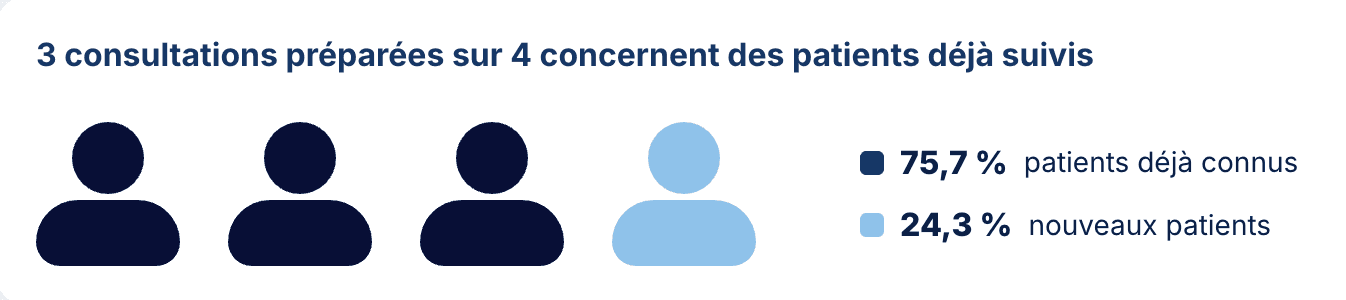
Breakdown of prepared consultations: already-followed patients vs new patients.
2. Pre-consultation AI knows no age limit
Pre-consultation is designed for all ages. Adult patients who prepared for their consultation range from 18 to 104 years old, with a median age of 48. In other words, this habit is not just for "young" patients; using a pre-consultation assistant is a reflex that people of all ages adopt.
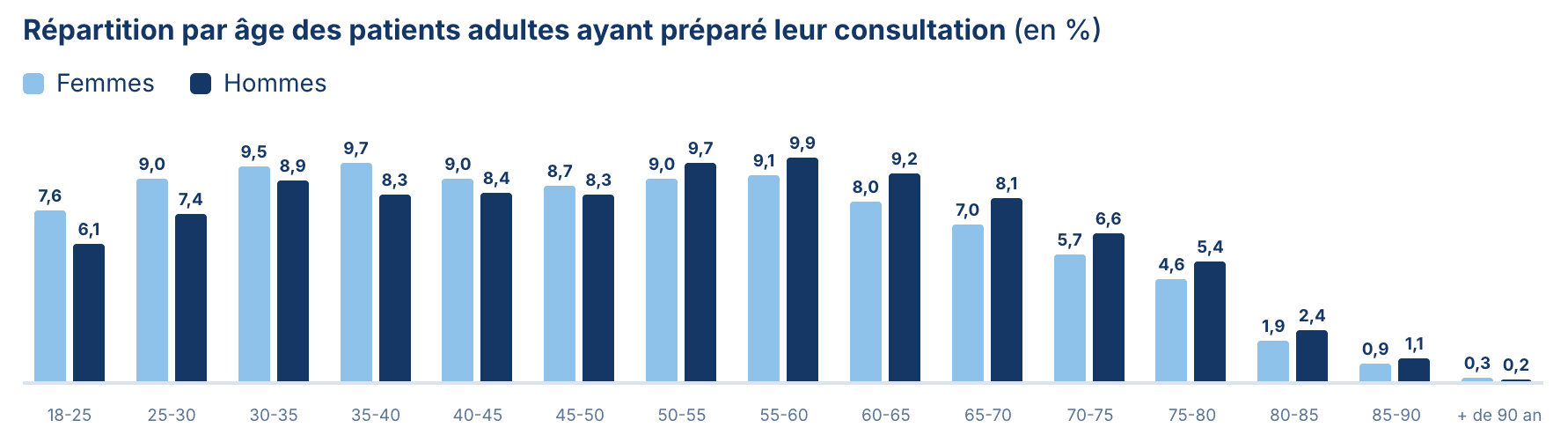
Age distribution of adult patients who prepared for their consultation (in %).
3. Women are the primary users of the tool
Women prepare 6 out of 10 consultations. This figure reflects a broader trend seen across the healthcare system: women consult healthcare professionals more often than men and, in many family structures, are highly involved in organising the healthcare journey. According to INSEE, in 2019, 88% of women had seen a general practitioner during the year compared to 80% of men, and 53% of women had seen a specialist compared to 42% of men.
We also observe different user profiles in the process, which align with the healthcare consumption habits observed in France. For women, usage is particularly high between the ages of 25 and 60, with a peak between 35 and 40 (9.7%). For men, it is more concentrated between the ages of 50 and 60. This distribution reflects different stages in the healthcare journey, such as gynaecological monitoring, pregnancy, and prevention for women, or increased medical monitoring with age and the management of chronic conditions for men.
These results demonstrate that the pre-consultation assistant naturally fits into different stages of patients' lives and supports varied healthcare needs, regardless of their age or the context of their consultation.
4. An approach accessible to a wide diversity of patients
Beyond the age of patients who agree to use a pre-consultation service, another question arises: is this approach truly accessible to everyone?
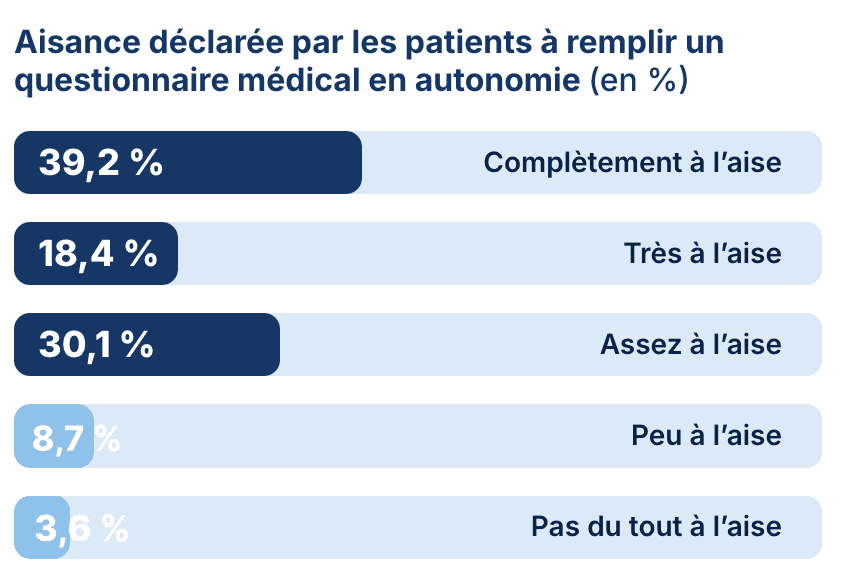
The results of the Aldebaran Barometer are clear: 87.7% of patients say they are comfortable enough to answer a digitalised medical questionnaire.
What is the concrete impact? Patients declaring themselves "not at all comfortable" (3.6% of patients) to fill out a medical questionnaire on their own answer an average of six fewer questions than other patients.
On the other hand, no significant difference is observed between the other levels of health literacy. These results suggest that the pre-consultation assistant remains globally accessible to the vast majority of patients (96.4%), including the 8.7% reporting intermediate health literacy.
5. One in five carers behind consultation preparation: the AI tool as a healthcare pathway facilitator
81.4% of prepared consultations were carried out by the patients themselves and 18.6% by a carer (a relative, parent, or companion).
This significant proportion highlights the essential role of carers in accessing healthcare, particularly for elderly people experiencing a loss of autonomy or facing medical situations requiring support.
In other words, when autonomy is not total, the support of a relative or carer helps to remove most of the barriers.
\ a carer can be a parent for their child, an adult for their parents, a third-party companion (due to a loss of autonomy, illness, disability, or age).*
6. Patient satisfaction confirmed through use
Adopting a new tool is a first step. But for it to truly find its place in the healthcare pathway, patients must continue to use it and perceive its value over the course of successive consultations.
The Barometer results support this. Patients using Aldebaran for the first time gave an average rating of 17.6/20. This rating remains virtually identical for patients who have already used the pre-consultation multiple times, at 17.5/20.
More than just a good level of satisfaction, these results show that the experience remains positive over time. The value of pre-consultation does not seem to rely on a simple novelty effect, but rather establishes itself sustainably in patients' habits.
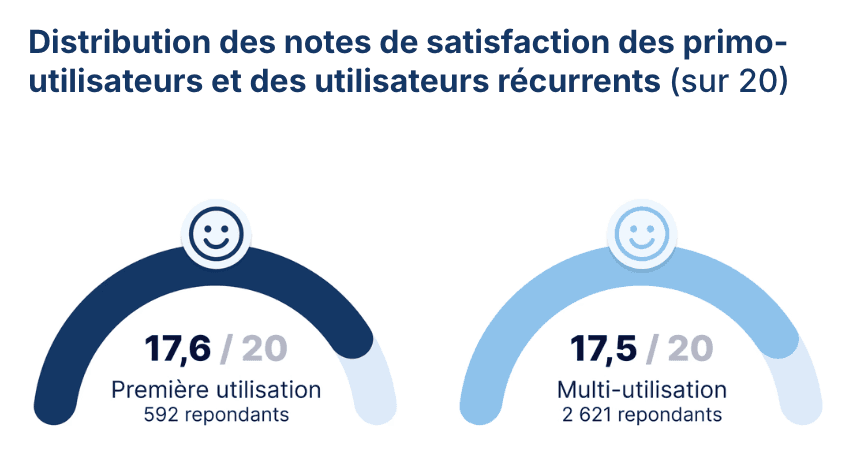
Note: the data and percentages presented in this 6th part come from the Aldebaran Patient In App survey Q4 2025 – Q1 2026 (3,213 respondents).
On the doctors' side: what pre-consultation changes on a daily basis
When healthcare professionals talk about pre-consultation, one question often comes up: "Does it really change anything in my day?"
The numbers speak for themselves. Feedback from 135 healthcare professionals surveyed in April 2026 shows that the benefits are not limited to time saved: they also affect the comfort of practice, the quality of consultations, and the appreciation of medical work.
1) Perceived time saving in consultation
Time is the first improvement reported by healthcare professionals. When the reason for consultation, medical history, treatments, or risk factors are already collected before the appointment, the consultation starts in better conditions.
The physicians surveyed estimate they save an average of 5 minutes per consultation prepared with Aldebaran (median gain: 3.5 minutes).
This saved time makes it possible to reduce the collection of information during the consultation and to dedicate more time to the discussion with the patient and medical care.

2) More stable practice comfort, consultation after consultation
After the time saved, the most visible benefit is often daily comfort.
Why? Because information arrives in a more structured format and the consultation becomes smoother.
Doctors have a clearer overview of their patient before the start of the appointment, allowing them to devote more time to conversation and the clinical examination.
In concrete terms, this gain in comfort relies on several elements:
More structured consultations (57.1%)
Fewer patient omissions (50%)
A lighter mental load (28.6%)
Less stress during consultation (7.1%)
These results show that the comfort provided by the pre-consultation does not rely on a single factor, but on a combination of improvements that make consultations calmer and easier to conduct on a daily basis.
3) A better prepared consultation, and a strengthened quality of care
Following the benefits observed in organization, time saved, and practice comfort, the doctors surveyed also highlight improvements directly concerning the quality of care.
In particular, they emphasize:
better prevention (87.5%)
more personalized care (87.5%)
earlier detection of certain weak signals (62.5%)
better anticipation of the reasons for consultations (37.5%)
and, more accurate diagnoses (25%).
When key information is already collected before the appointment, the consultation can focus more on clinical reasoning: deep-diving into the questioning, prioritizing, and adapting care to the patient.
These results suggest that Aldebaran is perceived not only as an organizational tool, but also as a lever for improving clinical quality and patient follow-up.

Detail of perceived benefits on quality of care and practice comfort
4) Perceived economic impact:
Finally, some professionals report a positive economic impact.
The idea behind this figure is simple: when information is better collected and better structured beforehand, the consultation is easier to document, and therefore to code/assess more accurately, with stronger traceability.
Ultimately, doctors describe the same dynamic: less wasted time, more comfort, and a consultation that gains in quality and traceability.
Note: the data and percentages presented in this 2nd section come from the Aldebaran 2026 Barometer (survey of professionals, April 2026, 135 respondents).
Conclusion
This first Aldebaran Barometer brings a strong conviction: pre-consultation is no longer in the experimental stage. It is adopted and on its way to becoming a new step in the care pathway.
The analyzed data shows that it naturally integrates into patient care, regardless of their age, profile, or reason, that it is sustainably adopted and that it produces concrete benefits for healthcare professionals: more useful time, better prepared consultations, and a better quality of care.
As medical time becomes an increasingly scarce resource, the question is no longer whether to prepare consultations beforehand, but how to do so in an intelligent, structured, and large-scale manner.
At Aldebaran, we are convinced that tomorrow, pre-consultation will become an essential infrastructure of the healthcare pathway: a step where health data is collected, structured, and enhanced before each consultation, for the benefit of patients, caregivers, and future decision-support tools.
This first Aldebaran Barometer is therefore not a conclusion, but a starting point. We will continue to measure, document, and share the impact of this transformation, because we are convinced that the consultation of tomorrow will begin long before the patient enters the office. This is where part of the quality of care, the efficiency of the healthcare system, and the medicine of tomorrow will be played out.